Remediation vs. Risk Management: WhichIs Right for Contaminated Sites?
Environmental Compliance Solutions by Oz Geos
Contaminated land can pose serious environmental and health risks—especially when it comes to redevelopment, rezoning, or commercial use. But when contamination is discovered, property owners are faced with a crucial question:
Should we remediate the contamination or manage the risk?
At Oz Geos, we help clients make informed decisions through detailed site investigations and compliance-driven strategies. In this blog, we’ll break down the differences between remediation and risk management, and help you understand which approach is right for your site.
What is Site Contamination?
Contamination occurs when hazardous substances—like heavy metals, hydrocarbons, asbestos, solvents, or PFAS—are present in soil or groundwater at levels that could harm people, property, or the environment.
These pollutants may result from:
- Past industrial activity
- Fuel storage and spills
- Illegal dumping
- Agricultural chemicals
- Construction waste
Identifying and dealing with contamination is often required under EPA Victoria regulations and the National Environment Protection (Assessment of Site Contamination) Measure (NEPM).
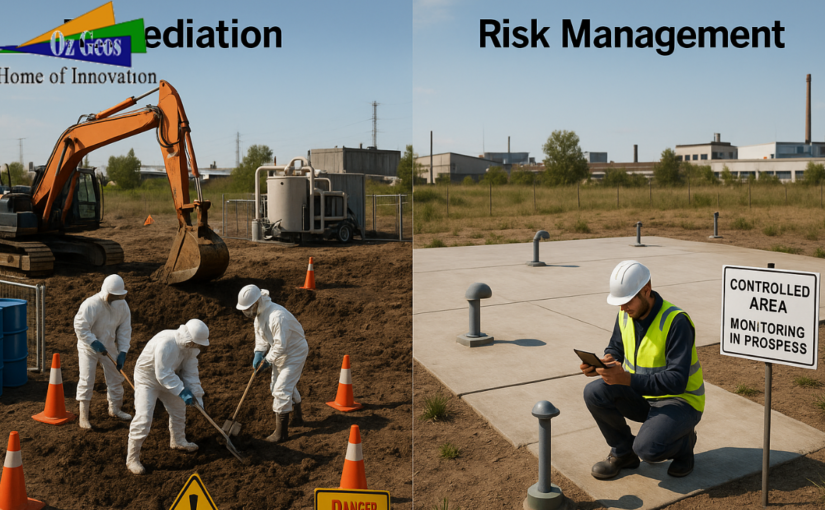
Two Main Strategies: Remediation vs. Risk Management
Remediation
Remediation refers to the physical removal, treatment, or neutralisation of contaminants to restore the site to an acceptable environmental condition.
Common remediation methods include:
- Soil excavation and disposal
- Groundwater extraction and treatment
- Bioremediation (using microbes to degrade pollutants)
- Chemical oxidation or stabilisation
- In-situ thermal or vapour extraction
Best for:
- Sites being redeveloped for residential use
- Sensitive locations (schools, parks, childcare centres)
- High concentrations of contamination
- Regulatory enforcement scenarios
Risk Management
Risk management focuses on containing or controlling contaminants, rather than removing them. This approach is based on assessing exposure pathways—how humans or the environment might come into contact with the contamination—and taking steps to break those pathways.
Risk management strategies include:
- Capping or covering contaminated soil
- Installing barriers or vapour systems
- Land use restrictions or planning overlays
- Ongoing monitoring and maintenance programs
Best for:
- Commercial or industrial sites with stable contamination
- Low-risk contaminants
- Situations where removal is impractical or cost-prohibitive
- Redevelopment with controlled access (e.g. carparks, warehouses)
Key Differences at a Glance:
| Feature | Remediation | Risk Management |
| Objective | Remove or neutralise contamination | Control exposure and limit risk |
| Cost | Often higher upfront | Lower upfront, ongoing costs possible |
| Use Case | Residential & sensitive land use | Commercial & industrial land use |
| EPA Compliance | Required in certain scenarios | Acceptable when exposure risks are low |
| Long-Term Monitoring | Usually not needed | Often required for compliance |
What Does Oz Geos Recommend?
Every contaminated site is unique. At Oz Geos, we start with a comprehensive Environmental Site Assessment (ESA) to evaluate:
- Type and extent of contamination
- Risk to human health and the environment
- Intended land use
- Applicable regulatory guidelines
- Feasibility of remediation vs. risk control
We then provide a clear, cost-effective action plan—whether that means full remediation, risk-based management, or a hybrid solution.
Full Support from Start to Finish
Oz Geos offers:
- Phase 1 & 2 Environmental Site Assessments
- Contamination mapping and laboratory analysis
- Remediation Action Plans (RAPs)
- Site Management Plans (SMPs)
- Validation and compliance reporting for council and EPA
Whether you’re preparing land for sale, development, or regulatory approval, we ensure your project proceeds safely and legally.
Need Help Managing a Contaminated Site?
Contact Oz Geos today to discuss your site’s specific needs. Our environmental experts will help you determine whether remediation or risk management is the right solution—and guide you every step of the way.